
Sweetgum Pollen: The Spiky-Ball Tree's Spring Flowering
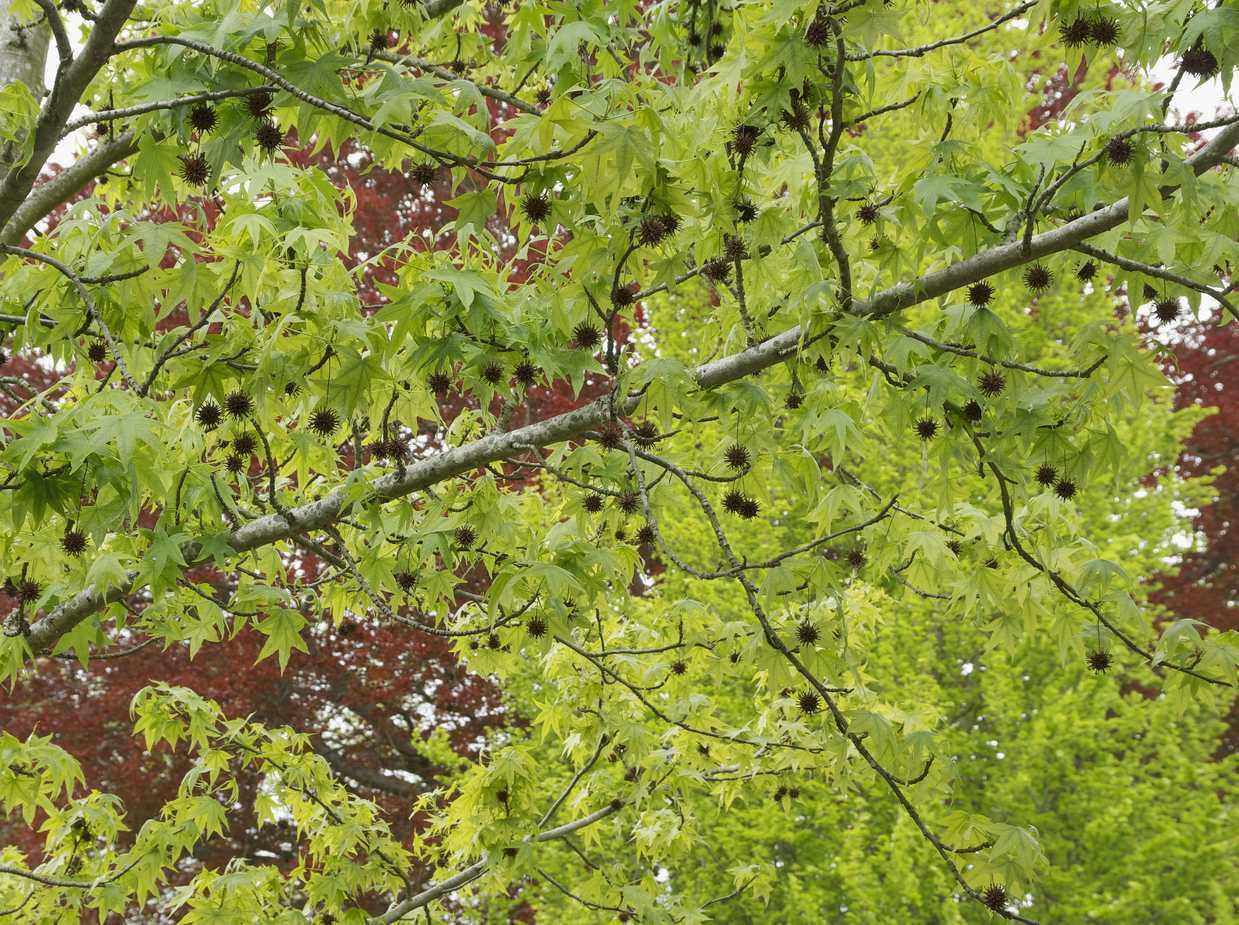
Sweetgum pollen belongs to one of the most recognizable trees in the American Southeast and mid-Atlantic. Almost everyone who has walked a southern sidewalk knows the tree by its calling card — the spiky, ball-shaped seed pods that litter lawns and crunch underfoot — but fewer people connect it to the spring pollen season, when the same tree flowers early, before its star-shaped leaves open, and adds its pollen to the April crest. Sweetgum is planted everywhere in its range: as a street tree, a yard tree, and a fast-growing shade tree, which puts its flowering canopy directly over the neighborhoods where people spend the spring.
Key takeaways
- Sweetgum pollen is released in spring, generally March into April in the Southeast and April further north, as the tree flowers before or as its leaves emerge — per the USDA Forest Service species profile for Liquidambar styraciflua.
- Sweetgum is one of the most common bottomland and street trees of the Southeast and mid-Atlantic, and the AAAAI National Allergy Bureau includes it among the tree pollens identified at southern counting stations.
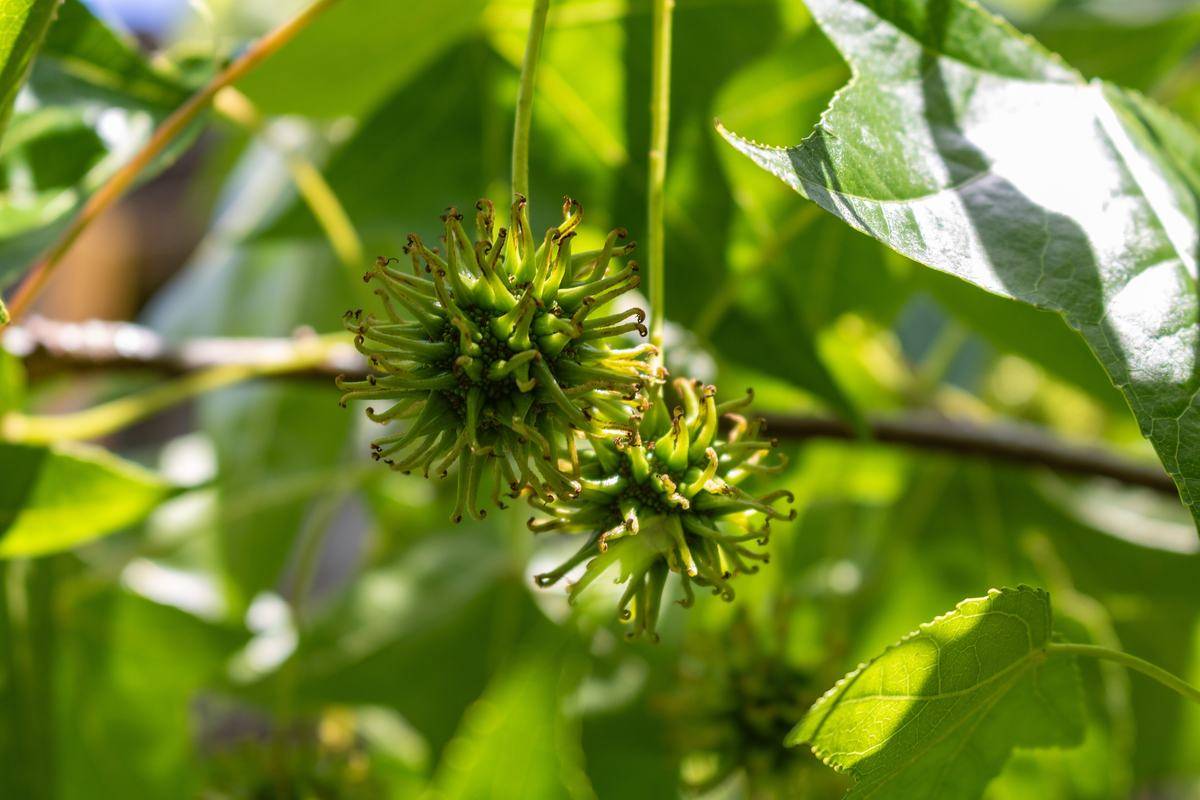
- The tree's famous spiky seed balls are its fruit, not its flowers — the pollen comes from separate, less conspicuous flower clusters earlier in spring.
- Pollen Atlas data shows sweetgum contributing to spring Tree Index readings across the Carolinas and Georgia during the March–April build toward the oak crest.
Recognizing the tree that makes sweetgum pollen
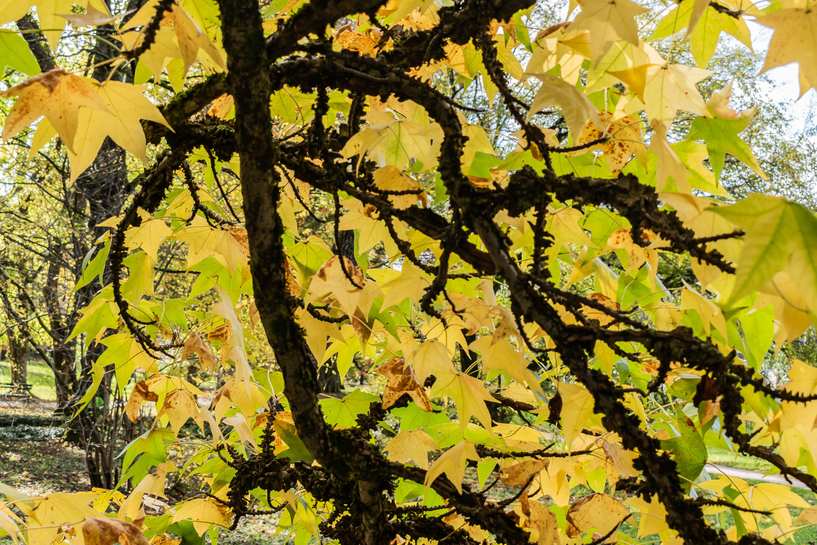
American sweetgum — Liquidambar styraciflua — is a tall, straight-trunked tree of bottomlands, stream edges, and moist soils across the Southeast, growing naturally from the Gulf Coast up the Atlantic plain and into the lower Midwest. The USDA Forest Service species profile describes it as one of the most important bottomland hardwoods in the South, and landscapers adopted it for the same qualities the forest shows: fast growth, a tidy pyramidal young shape, and star-shaped leaves that turn deep red and purple in fall.
The spiky balls are the tree's signature — but not its pollen
The round, spiked seed balls are the recognition hook, and they hang on the tree through winter into spring, so they are often still visible when the new season starts. The flowers are a different structure entirely. Sweetgum is monoecious — male and female flowers on the same tree — with male flowers in upright clusters that produce the pollen and female flowers in small hanging balls that, once pollinated, harden over the year into the famous spiky fruit. When you see last year's seed balls overhead and fresh green flower clusters emerging, you are looking at the tree mid-handoff between seasons.
When sweetgum flowers
Flowering follows the southeastern spring. The Forest Service profile places sweetgum flowering in March and April across most of its range, earlier toward the Gulf and later at its northern edge, timed before or alongside leaf-out. That timing puts sweetgum in the first rank of the southern tree season — ahead of the oak crest, alongside maple and elm — and in Charlotte and Raleigh, its readings build through March as the wider North Carolina allergy season gathers strength.
| Region | Typical sweetgum flowering | Season character |
|---|---|---|
| Gulf Coast and Florida panhandle | February–March | Earliest; overlaps late maples |
| Southeast (Carolinas, Georgia) | March–April | Core window; builds toward oak crest |
| Mid-Atlantic | April | Later; overlaps oak and hickory |
| Northern edge (lower Midwest) | April–early May | Shortest window |
In Atlanta, Piedmont sweetgums flower through the same March–April stretch as the city's famous spring build, one voice in a chorus that the full tree pollen season guide sets out tree by tree.
A street tree's footprint
Wild sweetgum is a bottomland tree, but planted sweetgum is an everywhere tree. Municipal planting programs favored it for decades across the South and mid-Atlantic, and it self-seeds readily into field edges and empty lots. The practical effect for pollen is distribution: instead of concentrating in wet woodland, sweetgum flowering is spread across the street grid, which is why its contribution registers at urban counting stations even though the tree never dominates a count the way oak can.
How sweetgum pollen fits the spring
A supporting voice in a loud chorus
The Asthma and Allergy Foundation of America lists the spring tree wave as the season's first major pollen event, and sweetgum plays a supporting but consistent part in the southern version of that wave. The AAAAI's National Allergy Bureau counts Liquidambar among the pollens identified at its southeastern stations, where its seasonal curve rises early, crests with the general March–April build, and fades as grasses begin.
Daily swings follow the standard spring mechanics, amplified by placement. A warm, dry, breezy week in late March can push a whole street of sweetgums to release together; rain pauses the show briefly. Because the canopy in question overhangs sidewalks, schoolyards, and parking lots, local exposure can run ahead of what a regional average suggests — the recurring theme of planted-tree pollen, from mesquite in the desert to sweetgum in the South.
Tracking sweetgum on Pollen Atlas
On Pollen Atlas, sweetgum is tracked within the daily Tree Index — scored 0 to 100, Low from 0 to 33, Moderate from 34 to 66, and High from 67 to 100 — with per-plant detail on each city page showing when sweetgum itself is contributing. In March and April, the national city rankings show the southeastern build in near-real sequence: Gulf cities first, the Carolinas and Georgia next, the mid-Atlantic closing the wave.
For readers who want to work out which pollens affect them, the Find an Allergist directory lists specialists as a reference. This article is general information only and is not medical advice.
Frequently Asked Questions
When is sweetgum pollen season?
Sweetgum pollen season is in spring — generally March into April in the Southeast, February–March near the Gulf Coast, and April at the tree's northern edge. The tree flowers before or as its star-shaped leaves emerge, early in the southern tree season.
Are the spiky balls on a sweetgum tree the pollen source?
No — the spiky balls are the tree's fruit, formed from the previous year's female flowers. Sweetgum pollen comes from separate male flower clusters that emerge fresh each spring, often while some of last year's seed balls are still hanging on the tree.
Where is sweetgum pollen most common?
Sweetgum pollen is most common across the Southeast and mid-Atlantic, where the tree grows wild in bottomlands and is planted heavily as a street and yard tree. Charlotte, Raleigh, and Atlanta all sit in the heart of its range.
How strong a pollen producer is sweetgum?
Sweetgum is a consistent, moderate contributor to the southern spring count rather than a dominant one. Its importance comes from distribution — it is planted across whole street grids — so its pollen registers steadily through March and April alongside maple, elm, and oak.
Conclusion
Sweetgum pollen is the spring contribution of a tree most southerners know by its fruit: an early-flowering, widely planted southeastern hardwood whose season opens in March and builds toward the April crest. Recognize the tree — spiky balls overhead, flower clusters emerging — and you can read one more line of the spring count at a glance. Know before you head out — free pollen counts and forecasts, worldwide: PollenAtlas.com
Sources: USDA Forest Service, species profile for Liquidambar styraciflua (American sweetgum); American Academy of Allergy, Asthma & Immunology, National Allergy Bureau counting-station network; Asthma and Allergy Foundation of America, pollen allergy education material; Pollen Atlas city index data for Charlotte, Raleigh, and Atlanta.